
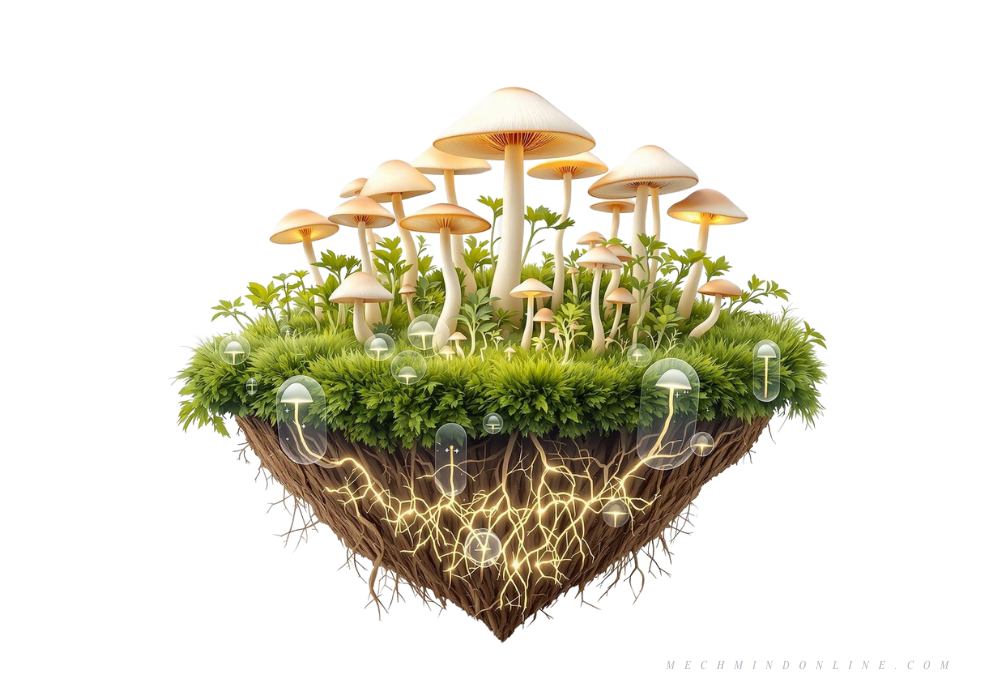
Are mushrooms linked to mini-earthquakes—and could fungi help us sense seismic stress?
Possibly—but the idea is still early and mostly exploratory. The most plausible connection is that tiny ground movements and shifts in soil moisture/chemistry in active regions could influence underground fungal networks (mycelium), which in turn changes when and where mushrooms fruit. That makes fungi a fascinating potential environmental signal—without implying mushrooms “cause” earthquakes.
Unveiling Nature’s Hidden Wonders: The Astonishing Connection Between Mushrooms and Mini-Earthquakes
What if I told you that mushrooms might be quietly connected to tiny earthquakes beneath our feet? It sounds like something out of a fantasy novel—but emerging research suggests there may be more truth to this than fiction.
Let’s unpack the who, what, when, where, and why behind this unexpected relationship—and why it could reshape how we understand the world beneath us.
Are mushrooms really linked to earthquakes?
In short: maybe. Recent studies are revealing a surprising correlation between mushroom growth and minor seismic activity—especially in places like the Pacific Northwest, where both are remarkably common. Scientists are just beginning to explore the possibility that underground fungal networks—specifically, the intricate mycelium systems—might not just respond to seismic activity, but perhaps even influence it in subtle ways.
This doesn’t mean mushrooms are causing earthquakes. But it opens the door to the idea that the living networks underground may be more in tune with the Earth’s geological rhythms than we’ve ever imagined.
Important nuance: a “correlation” (if it holds up) would most likely reflect shared environmental drivers—like soil disturbance, moisture shifts, temperature, pressure changes, or chemistry—not a simple “mushrooms → earthquakes” cause-and-effect story. Also, while fungi might someday help with monitoring conditions, authoritative sources like the U.S. Geological Survey (USGS) stress that earthquakes can’t currently be predicted in the specific time/place/magnitude sense.
What’s the science behind this?
To really grasp what’s going on, we need to understand the basics of mycorrhizal fungi. These are underground webs of fungal threads that live in symbiosis with plant roots. They help trees and plants absorb water and nutrients while receiving sugars in return. Think of them as nature’s internet—connecting vast areas of forest underground.
Now, layer that with the fact that the Pacific Northwest sits atop the Cascadia Subduction Zone, a region with frequent micro-earthquakes. These tiny tremors—often too small to be felt—are part of the Earth’s constant tectonic dance.
So where’s the connection? Some researchers suspect that the shifting soils and micro-movements in seismic zones could influence mycelial growth patterns. Others wonder if changes in the fungi’s activity might even serve as early indicators of geological stress. The idea is still in its infancy, but it’s captivating scientists across disciplines.
Helpful context if you’re thinking “big picture” risk: organizations that track Cascadia hazards (including regional seismic networks like PNSN) share long-range probabilities and scenario planning—but that’s different from short-term prediction. It’s about understanding risk over years/decades, not forecasting tomorrow’s quake.
Why does this matter now?
Understanding this potential link could be a game-changer—for science, for industry, and for how we live with the Earth.
- Ecologists might gain deeper insight into how resilient forest ecosystems are in the face of natural disruptions.
- Seismologists could investigate whether fungal behavior adds any useful signal to broader earthquake monitoring and probabilistic hazard modeling.
- Agriculture and land management strategies could shift, incorporating fungi-based indicators into sustainable practices.
- Biotech and ecosystem restoration teams might explore whether living fungal systems can act as real-time monitors of environmental stability.
Can fungi really help predict earthquakes?
That’s the big question. Right now, we don’t have definitive proof—but we do have compelling clues. Some scientists are investigating whether engineered fungi might be used to detect or even respond to ground movement in real time. Others are looking into how changes in mycelial growth might precede certain types of seismic activity.
- Imagine a future where mushroom-like sensors in the soil help communities prepare for earthquakes.
- Or where restoring fungal networks becomes part of how we build more resilient ecosystems in seismic zones.
Reality check (and still exciting): “prediction” is often used casually, but seismology draws a hard line between prediction (specific time/place/magnitude) and forecasting/hazard (probabilities over longer windows). If fungi ever help here, the near-term win is more likely to be new monitoring signals rather than crystal-ball forecasting. For a clear explainer, see the Pacific Northwest Seismic Network overview.
What’s next in this research?
Interdisciplinary collaboration will be key. Mycologists, geologists, ecologists, and technologists are beginning to work together, asking new questions and forging new paths. This isn’t just about fungi or earthquakes—it’s about understanding the deeper language of Earth’s systems, and how living organisms might help us listen better.
- Mycologists mapping how mycelium behaves under different soil stresses.
- Geologists and seismologists comparing fungal patterns against micro-seismic datasets and ground deformation signals.
- Ecologists studying how fungal shifts ripple through forests and plant health.
- Technologists exploring bio-sensing approaches that could translate biological changes into readable environmental data.
For now, the connection between mushrooms and mini-earthquakes remains a mystery in motion—but it’s one that invites awe, curiosity, and an urgent call to explore more.
Quick takeaway
Mushrooms might be doing more than nourishing our forests—they could be quietly dancing with the Earth’s tectonic pulse. The more we learn, the more we see: nature is not just interconnected. It’s inseparable.
Read more at Superhuman.ai
Key Takeaways
The “mushrooms + micro-earthquakes” idea is less about fungi triggering quakes and more about fungi potentially reflecting subtle changes in soil conditions in geologically active places. If the hypothesis holds up, fungal networks could become an intriguing layer in broader environmental monitoring—alongside existing seismic and geodetic tools.
- Mushrooms emerge from vast underground mycelium networks that can respond to environmental shifts.
- In active regions like the Cascadia Subduction Zone, micro-movements and soil changes may influence fungal growth patterns.
- The most realistic near-term value is improved monitoring and ecosystem insight—not guaranteed short-term earthquake prediction.
- Progress depends on cross-disciplinary research that pairs fungal biology with seismic and environmental datasets.